
Why Covered Parking Has Become Essential in Pakistan
Pakistan's summers are unforgiving to vehicles. A car parked in direct sun through a June afternoon in Islamabad can reach cabin temperatures that damage dashboards, fade upholstery, crack leather, and age the paint. Beyond comfort, there is real cost: more air-conditioning load, faster interior deterioration, and reduced resale value.
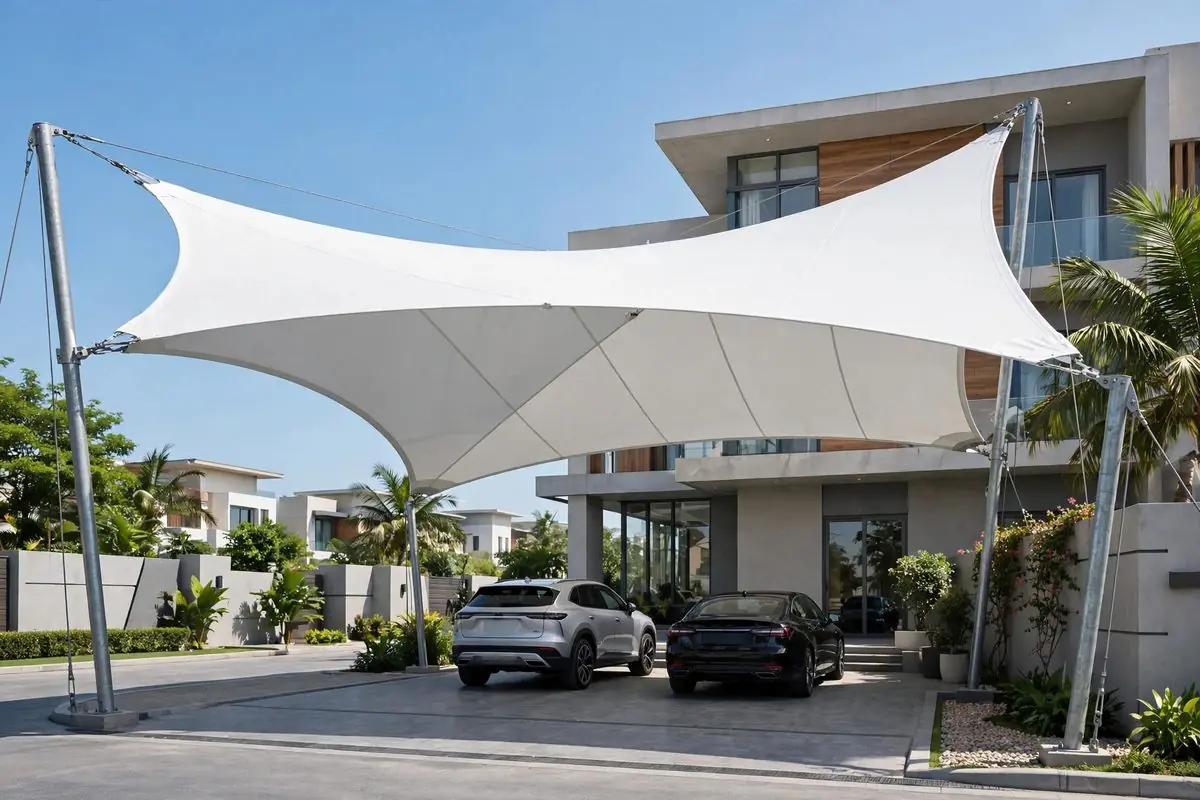
Covered parking solves this, and for commercial plazas, offices, schools, hospitals, and residential societies, the question is not whether to provide shade but which type of parking shade offers the best balance of cost, durability, and appearance. The two main options in Pakistan are tensile fabric shades and fiber (fiberglass) shades. This guide compares them honestly and explains what drives the price of each.
BPC Company designs and installs tensile fabric shade structures including car parking shades from our Islamabad and Swat branches. We focus on tensile systems because of their structural efficiency and design flexibility, but this guide covers both options so you can make an informed comparison.
Tensile Fabric Parking Shades: How They Work
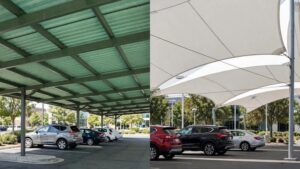
A tensile shade uses a high-strength fabric membrane stretched over a steel structure. The fabric is tensioned into curved shapes, such as hypar (saddle), cone, or barrel vault forms, that are both structurally efficient and visually distinctive. The tension in the fabric is what gives the structure its strength, allowing large spans with relatively light steelwork.
The fabric is typically PVC-coated polyester or PTFE-coated fiberglass. These membranes block the vast majority of UV radiation while allowing some diffused light through, so the shaded area stays bright without the harsh glare. Quality fabrics carry UV resistance and weatherproofing as inherent properties, not surface treatments that wear off.
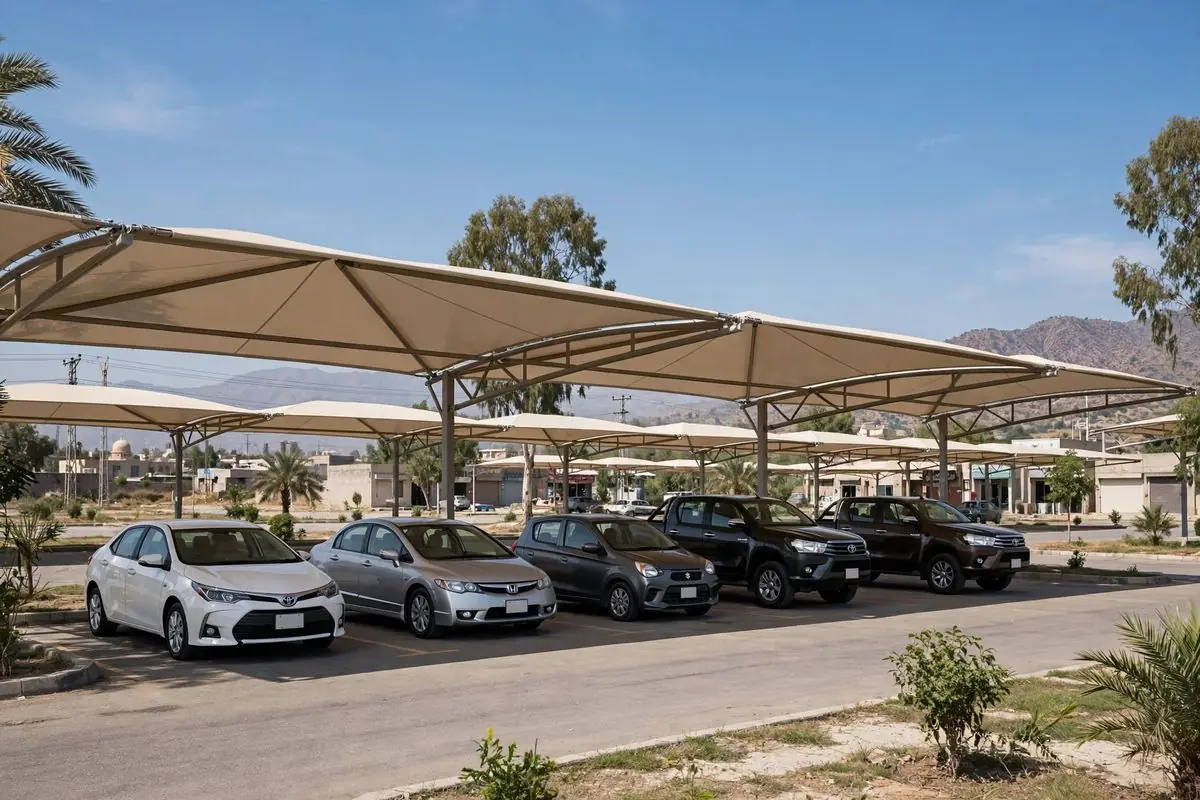
Tensile shades suit larger installations particularly well: multi-car parking rows, plaza parking areas, school pickup zones, and commercial compounds. The spanning capability means fewer columns, which means fewer obstructions for vehicles maneuvering underneath.
Fiber (Fiberglass) Parking Shades: How They Work
Fiber shades use rigid fiberglass sheets mounted on a steel frame. The sheets are typically corrugated or flat panels in translucent or opaque finishes. The structure is a conventional steel frame with purlins supporting the sheets, similar to a light roof.
Fiber shades are a familiar sight across Pakistan. They are straightforward to fabricate, the materials are widely available, and most steel fabricators can build them. For a single car porch or a small parking area, they are often the lower-cost option upfront.
The limitations are span and aesthetics. Fiberglass sheets need frequent support, so the frame requires more columns and purlins. Over time, fiberglass sheets can yellow, become brittle, and develop leaks at fixing points. In hail or heavy impact, they can crack. These are well-known characteristics, not defects of any particular supplier.
Tensile vs Fiber: Honest Comparison
Upfront cost. For small single-car installations, fiber shades usually cost less upfront. The materials are cheaper and the fabrication is simpler. For larger multi-car installations, the gap narrows because tensile structures need less steel per square foot of coverage, offsetting the higher fabric cost.
Lifespan and maintenance. Quality tensile membranes are engineered for long outdoor service with minimal maintenance, typically just periodic cleaning. Fiberglass sheets degrade faster under UV exposure and usually need replacement of sheets within a shorter timeframe. Over a ten-year horizon, the total cost of ownership often favors tensile.
Appearance. This is subjective but relevant for commercial properties. Tensile structures have a modern, architectural look that enhances a property's image. Fiber shades look utilitarian. For a plaza, corporate office, or premium residential society, the visual difference matters to stakeholders.
Span and columns. Tensile structures span further with fewer columns. In a parking area, every column is an obstacle and a potential collision point. Fewer columns mean easier parking and less risk of vehicle damage.
Light quality. Tensile membranes diffuse light evenly. Opaque fiberglass creates a darker space underneath that may need daytime lighting. Translucent fiberglass admits light but can create glare spots.
Wind resistance. Both need proper engineering, but tensile structures are designed with wind loads as a primary consideration because the membrane's shape interacts with wind. Any shade structure in Pakistan should be engineered for local wind conditions, not just built to look right.
What Determines Parking Shade Price
Whether tensile or fiber, these factors drive the cost:
- Covered area. Total square footage is the primary driver. Larger installations benefit from economies of scale in fabrication and installation.
- Structure type. Tensile membrane vs fiberglass sheets, as compared above.
- Steel specification. Column size, beam sections, and foundation depth. Proper structural design costs more than undersized steelwork but is what keeps the shade standing in a storm.
- Foundation work. Column foundations must suit the soil conditions. Soft or filled ground needs deeper foundations.
- Fabric or sheet quality. Membrane grade and coating for tensile; sheet thickness and UV stabilization for fiber.
- Design complexity. A simple flat canopy costs less than an architecturally shaped tensile structure with multiple peaks. The visual impact comes at a fabrication premium.
- Drainage. Water must go somewhere. Proper guttering and drainage design, especially for larger structures.
- Site access and location. Urban sites with easy access cost less to build on than remote or constrained sites.
- Finishing. Powder coating colors, edge details, and lighting integration.
BPC provides engineered quotations for tensile parking shades after a site visit, because foundation requirements and structural design depend on your specific location and soil.
Getting a Parking Shade Quote from BPC
Share your location and the approximate area or number of cars to be covered. We visit the site, assess ground conditions and access, discuss design options from functional to architectural, and provide a written quotation with structural specifications.
For Islamabad, Rawalpindi, and Jhelum, WhatsApp 03126175608. For Swat, Shangla, Dir, Buner, and Peshawar, WhatsApp 03339477778.
Our tensile fabric shade structures cover more than parking: school courtyards, commercial terraces, swimming pool shades, and playground covers use the same engineering.
FAQs
How much does a car parking shade cost in Pakistan? It depends on the area, structure type, steel specification, and site conditions. A single-car fiber porch and a twenty-car tensile parking structure are completely different projects. We quote after a site assessment because foundation and structural requirements vary by location.
Is tensile shade better than fiber shade for parking? For larger installations and commercial properties, tensile usually wins on lifespan, appearance, and total cost of ownership. For a small single-car porch on a tight budget, fiber can be the pragmatic choice. We advise based on your specific situation rather than pushing one option.
How long do tensile fabric shades last? Quality membranes are engineered for extended outdoor service. Actual lifespan depends on the fabric grade, installation quality, and maintenance. We specify fabrics with documented performance characteristics.
Do parking shades need planning approval? Regulations vary by housing society and municipality. Some societies have specific rules about structures in setbacks or common areas. Check with your society management or local authority before construction. We can advise on typical requirements in DHA, Bahria Town, and similar developments.
Can tensile shades withstand strong winds and rain? Yes, when properly engineered. Wind load calculation is a standard part of tensile structure design. The membrane shape is actually advantageous in wind because it avoids the flat surfaces that catch gusts. Monsoon rain runs off the curved surfaces by design.
How many cars can one tensile structure cover? Tensile structures are modular and scalable. A single bay covers two cars comfortably, and bays can be repeated for larger parking areas. We design the layout around your site dimensions and vehicle circulation needs.
Do you provide the steel structure as well, or just the fabric? BPC provides the complete structure: steel fabrication, foundations, membrane, and installation. A shade is only as good as its weakest component, so we keep the entire project under our accountability.
What maintenance do tensile shades need? Periodic visual inspection and occasional cleaning of the membrane. The steel structure should be checked for coating integrity. Compared to repainting a conventional steel shed every few years, maintenance is light.
You May Also Like
Still have questions?
Chat with our team on WhatsApp for a free site visit and written quotation. We reply within minutes during working hours.